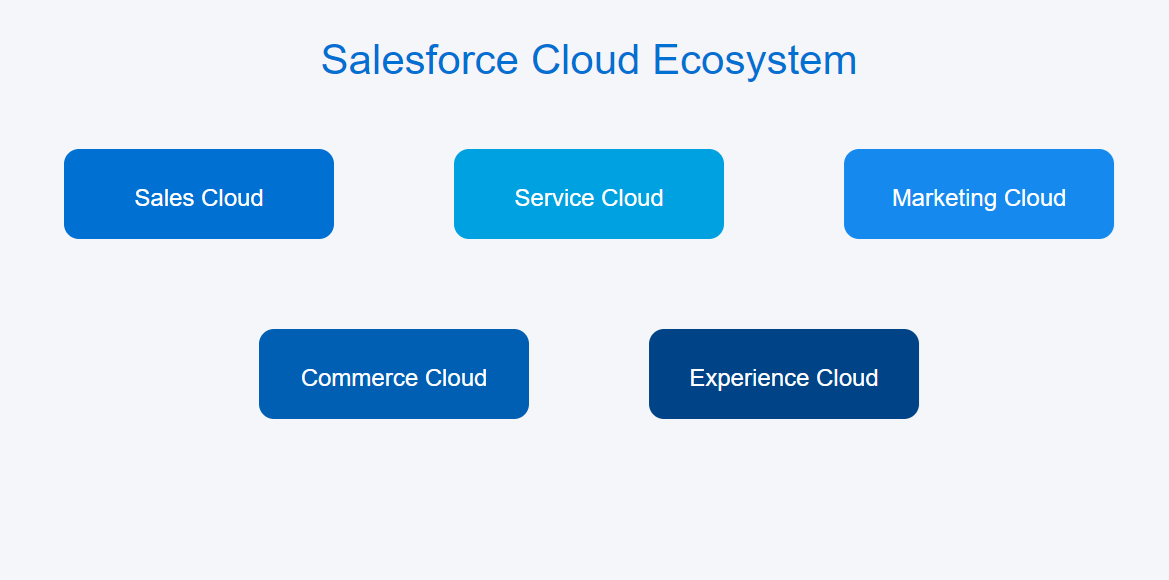
Salesforce Clouds are a collection of cloud-based platforms designed to manage customer relationships, automate business processes, and deliver personalized experiences across the customer lifecycle.
This guide explains all Salesforce Clouds in detail, how they work, and why businesses rely on them to scale faster.
What Are Salesforce Clouds?
Salesforce Clouds are specialized cloud services built on the Salesforce CRM platform. Each cloud focuses on a specific business function such as sales, service, marketing, analytics, or application development.
Together, they form a connected ecosystem where all customer data lives in one place.
Types of Salesforce Clouds (Detailed Breakdown)
Sales Cloud – Salesforce CRM for Sales Teams
Sales Cloud is the most widely used Salesforce Cloud, helping organizations manage leads, opportunities, and revenue pipelines.
Key Features of Sales Cloud
- Lead & Opportunity Management
- Account & Contact Management
- Sales Forecasting & Reports
- Workflow Automation
- Einstein AI Insights
Who Should Use Sales Cloud?
- Sales teams
- Account managers
- Revenue leaders
Sales Cloud improves productivity and gives real-time visibility into the sales pipeline.
Service Cloud – Salesforce Customer Support Platform
Service Cloud enables businesses to deliver fast, personalized customer service across multiple channels.
Key Features of Service Cloud
- Case Management
- Omni-Channel Routing
- Live Chat & Chatbots
- Knowledge Base
- Service Analytics
Best For
- Customer support teams
- Contact centers
- Customer success teams
Service Cloud helps reduce resolution time and improve customer satisfaction.
Marketing Cloud – Salesforce Digital Marketing Solution
Marketing Cloud allows marketers to create personalized, automated customer journeys using real-time data.
Key Features of Marketing Cloud
- Email Marketing
- SMS & Mobile Messaging
- Journey Builder
- Audience Segmentation
- AI-Powered Personalization
Best For
- Marketing professionals
- Campaign managers
- Growth teams
Marketing Cloud helps deliver the right message to the right customer at the right time.
Commerce Cloud – Salesforce E-Commerce Platform
Commerce Cloud supports both B2B and B2C digital commerce experiences.
Key Features of Commerce Cloud
- Online Storefronts
- Product Personalization
- Order Management
- AI Product Recommendations
Best For
- E-commerce businesses
- Retail brands
- Digital marketplaces
Experience Cloud – Customer & Partner Portals
Experience Cloud allows businesses to build custom digital experiences connected to Salesforce data.
Key Features
- Customer Portals
- Partner Communities
- Employee Intranets
- Secure Data Access
Data Cloud – Salesforce Customer Data Platform
Data Cloud unifies customer data from multiple sources into a single real-time profile.
Key Features
- Data Unification
- Identity Resolution
- Real-Time Customer Profiles
- AI-Driven Insights
Data Cloud is the foundation for personalization across all Salesforce Clouds.
Analytics Cloud – Salesforce Reporting & AI Insights
Analytics Cloud (Tableau & Einstein Analytics) transforms raw data into actionable insights.
Key Features
- Interactive Dashboards
- Predictive Analytics
- Real-Time Reporting
Integration Cloud – MuleSoft by Salesforce
Integration Cloud connects Salesforce with external systems using APIs.
Key Features
- API Management
- App Integration
- Data Synchronization
Salesforce Platform & App Cloud
Salesforce Platform enables developers to build custom applications using low-code and pro-code tools.
Key Features
- Apex Programming
- Lightning Web Components
- AppExchange Marketplace
How Salesforce Clouds Work Together
All Salesforce Clouds operate on one unified platform, enabling:
- Shared customer data
- Centralized security
- Seamless cross-team collaboration
This unified approach is one of Salesforce’s biggest strengths.
Benefits of Salesforce Clouds
- Scalable cloud architecture
- AI-powered insights
- Real-time data access
- Industry-specific solutions
- Strong security & compliance
Future of Salesforce Clouds
Salesforce is investing heavily in:
- AI-first CRM (Einstein GPT)
- Real-time data activation
- Industry-specific cloud solutions
- Hyper-personalized customer journeys
❓ FAQs (Rich Results Ready)
Salesforce Clouds are cloud-based services designed to manage sales, service, marketing, commerce, analytics, and application development.
Major Salesforce Clouds include Sales Cloud, Service Cloud, Marketing Cloud, Commerce Cloud, Experience Cloud, Data Cloud, Analytics Cloud, and Integration Cloud.
Sales Cloud is the best starting point for most businesses new to Salesforce.
Salesforce is both a CRM and a cloud platform offering multiple cloud services.